
Aristocrats: Resource Conversion Themes
How Sacrifice Engines Turn Small Advantages Into Inevitable Wins
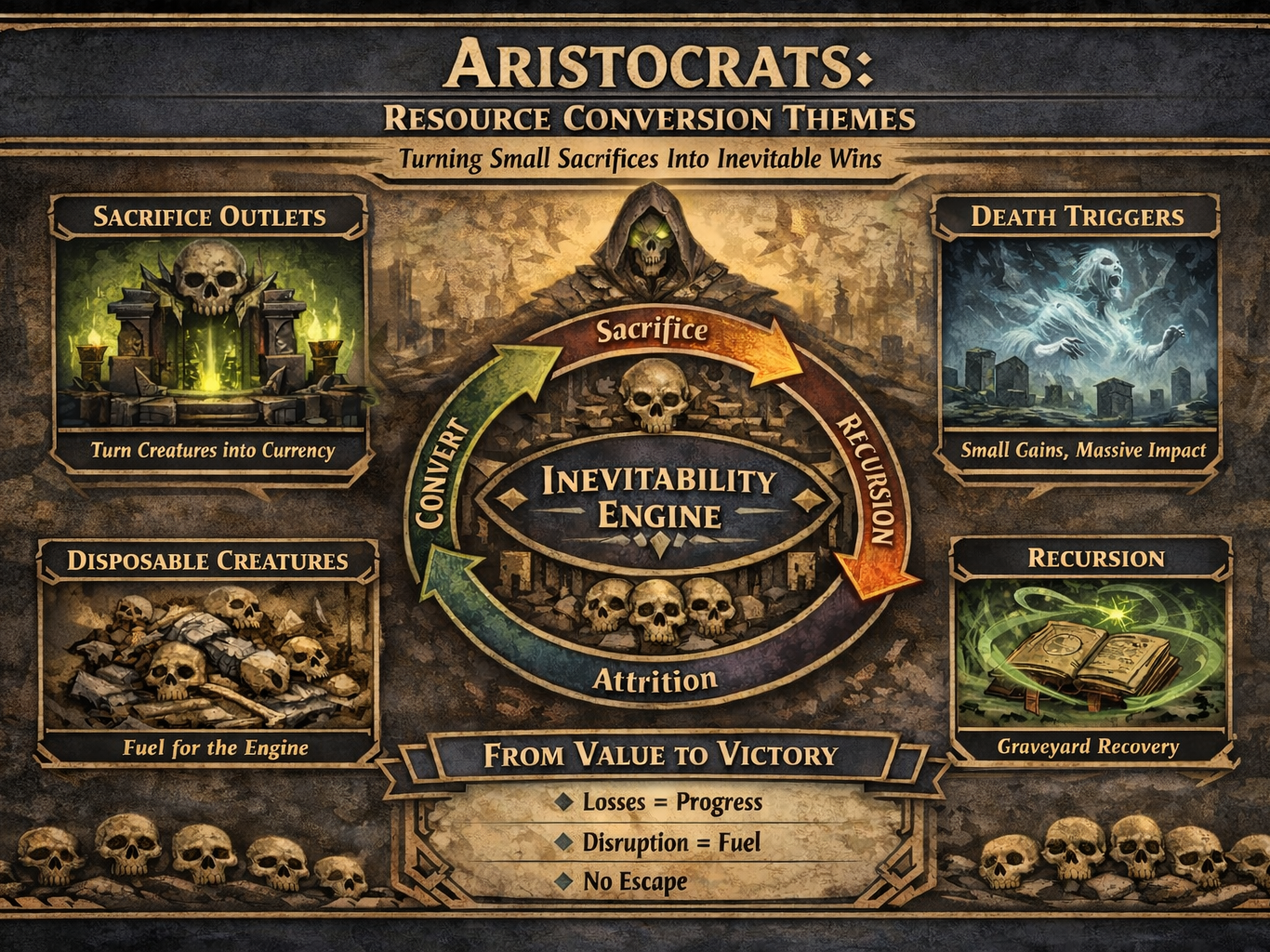
At first glance, Aristocrats decks can look chaotic.
Creatures enter, creatures die, life totals move in small increments, graveyards fill, boards change constantly. Nothing appears individually overwhelming. There is no single massive threat, no dramatic overrun moment, no obvious turning point.
And yet… games end.
Not suddenly.
Not explosively.
Inevitably.
Aristocrats strategies are built on one of the most powerful structural principles in Commander: conversion. Instead of relying on board presence or singular engines, they transform one resource into another repeatedly. Creatures become triggers. Triggers become value. Value becomes inevitability. The deck does not need a dominant turn because it reshapes the entire game’s economy. Opponents remove pieces, and those removals produce value. Creatures die, and death advances the plan. Interaction becomes fuel. This inversion is why Aristocrats decks feel resilient, frustrating to disrupt, and surprisingly lethal despite modest individual cards.
Aristocrats are not sacrifice decks. They are inevitability systems.
• Aristocrats strategies succeed by converting disposable resources into persistent advantage that compounds over time.
Sacrifice Outlets: The Engine Ignition
The defining structural element of Aristocrats decks is the sacrifice outlet. Without it, the archetype is decorative. Creatures dying incidentally do not create inevitability. Intentional death does. Sacrifice outlets create agency. They allow the pilot to determine when resources convert, preventing opponents from controlling value flow. Removal becomes optional rather than disruptive. Board wipes become opportunities rather than resets. Outlets vary in speed, cost, and flexibility, but their function is consistent: they transform creatures from static board pieces into dynamic currency. A strong Aristocrats deck does not ask whether creatures will die. It ensures they can.
• Sacrifice outlets give the deck control over resource conversion, which is essential for inevitability.
Death Triggers: Small Outputs, Massive Impact
Death triggers are the archetype’s pressure engine. Individually, they appear incremental — small life drain, card draw, token creation, recursion. Structurally, they scale through repetition. This scaling changes how value is perceived. Instead of large effects requiring protection, Aristocrats decks rely on cumulative inevitability. Opponents cannot easily interact with every trigger. Even partial disruption advances the plan. Death triggers shift the deck from threat presentation to resource erosion. The game tilts gradually rather than dramatically.
This is inevitability in its purest form.
• Death triggers create scaling pressure because repeated small outputs compound beyond traditional interaction thresholds.
Disposable Creatures and the Redefinition of Value
Aristocrats decks treat creatures differently than most archetypes. Creatures are not threats first. They are fuel. Their primary role is enabling conversion rather than surviving. This reframing changes deck construction. Cheap creatures, token producers, recursive bodies, and creatures with built-in value become structural assets. Efficiency is measured by conversion potential rather than combat impact. Disposable resources reduce risk. The deck can advance without overcommitting. Losses become part of the system rather than setbacks. Value becomes cyclical instead of linear.
• Aristocrats decks redefine creature value by prioritizing conversion potential over battlefield longevity.
Recursion: Maintaining the Loop
Recursion transforms Aristocrats from value decks into inevitability engines. Without recursion, sacrifice produces bursts. With recursion, it produces loops. The deck stops running out of material. Recursive pieces reduce dependency on draw variance. Engines sustain themselves. Interaction becomes less effective because removed pieces return. Resource flow stabilizes even under pressure. This continuity is what separates functional Aristocrats decks from ones that stall after early activity.
• Recursion ensures that resource conversion continues beyond initial production windows.
Life Drain as Structural Pressure
Life drain is often misunderstood as the win condition of Aristocrats. Structurally, it is the visible output of a deeper system. The real engine is conversion frequency. Drain reflects inevitability rather than creating it. This distinction matters because it influences density decisions. Increasing drain effects without improving production or recursion does little. Strengthening conversion frequency amplifies every drain piece simultaneously. Aristocrats decks do not race life totals. They erode them.
• Life drain functions as the scoreboard of inevitability rather than its source.
Combo Overlap: Natural Escalation
Aristocrats strategies frequently overlap with combo structures, sometimes unintentionally. Repetition, recursion, and conversion naturally create loops. These loops may be deterministic or simply highly efficient. This overlap is not a deviation from the archetype. It is an extension of its logic. Systems designed for inevitability eventually approach deterministic outcomes. The distinction lies in intent and density. Understanding this relationship helps players tune power without abandoning identity. The deck can operate as a value engine, a soft combo system, or a deterministic finisher depending on structural emphasis.
• Combo overlap emerges naturally from systems built around repeated resource conversion.
Inevitability Structure: Why Aristocrats Feel Hard to Stop
The most defining trait of Aristocrats is inevitability under interaction. Removing creatures produces triggers. Board wipes feed engines. Spot removal rarely eliminates the system entirely because roles are distributed across multiple pieces. This distributed structure makes disruption inefficient. Opponents must address engines, outlets, recursion, and payoffs simultaneously — a difficult requirement in multiplayer environments. The deck wins not because it cannot be stopped, but because stopping every component is resource-intensive.
• Aristocrats achieve inevitability through distributed engines that resist singular disruption.
Density Requirements and Failure Modes
Aristocrats decks fail when conversion layers are imbalanced. Too many payoffs without outlets create idle value. Too many outlets without recursion create burnout. Too little production starves the system. Too much linearity increases fragility. These failures often appear as inconsistency rather than weakness. The deck functions occasionally but lacks continuity. Adjusting density restores trajectory without changing identity.
Balance defines inevitability.
• Aristocrats stability depends on balanced density across outlets, production, recursion, and payoffs.
Interaction Through Conversion
Aristocrats decks interact differently than traditional strategies. Instead of preventing threats directly, they convert threats into value. Creatures dying becomes resource gain. Combat losses produce triggers. Removal accelerates inevitability. This does not replace traditional interaction but supplements it. The deck maintains agency even when answering threats indirectly. Interaction becomes part of progression rather than interruption. This structural advantage explains why Aristocrats often feel resilient even in hostile environments.
• Conversion-based interaction allows Aristocrats decks to maintain momentum while responding to threats.
Emotional Experience of the Archetype
Aristocrats decks create a unique emotional experience. Opponents feel pressure without obvious danger. Small life shifts accumulate. Engines persist through disruption. Wins feel gradual but unavoidable. Pilots often describe the deck as smooth or inevitable rather than explosive. This reflects structural pacing. The deck trades spectacle for continuity. Inevitability is less dramatic than power — but often more effective.
• Aristocrats create tension through gradual inevitability rather than visible spikes.
Meta Influence on Aristocrats
The archetype performs differently across metas but rarely disappears. Creature-heavy tables supply resources. Control metas test recursion. Combo environments compress timelines but still respect inevitability engines. Meta tuning usually adjusts interaction timing, recursion density, or conversion speed rather than abandoning the strategy. Aristocrats remain flexible because their core resource — death — exists in every game. This universality contributes to the archetype’s longevity.
• Aristocrats remain adaptable because their core resource exists regardless of meta conditions.
IntelliDeck’s Aristocrats Lens
IntelliDeck evaluates Aristocrats through conversion cadence, outlet density, recursion signals, and inevitability markers. This reveals whether the deck produces continuous pressure or isolated bursts. Visibility helps players identify whether the theme is functioning as a system or as a collection of synergistic cards. Adjustments become targeted rather than experimental. Aristocrats become measurable inevitability engines.
• Structural analysis reveals whether sacrifice loops create sustained inevitability or temporary value.
The Bottom Line
Aristocrats strategies demonstrate one of the most powerful structural principles in Commander: resource conversion creates inevitability. Sacrifice outlets provide control. Death triggers scale pressure. Recursion sustains loops. Life drain reflects system output. Combo overlap emerges naturally from repetition. The archetype wins not by presenting singular threats but by reshaping how value functions. Interaction becomes fuel. Loss becomes progression. Games end not through explosive turns but through cumulative certainty. Aristocrats decks do not overwhelm the table. They outlast it. Because inevitability does not need to be dramatic. It only needs to be continuous.
• Aristocrats succeed when repeated resource conversion produces pressure that persists regardless of disruption.
Browse our full library of Commander articles covering matchups, table dynamics, and advanced decision-making.
If you want help applying these ideas to your own commander, IntelliDeck can build a starting list, highlight improvements, and suggest upgrades that fit your playgroupCommander Articles
Browse Commander Articles Build A Deck